
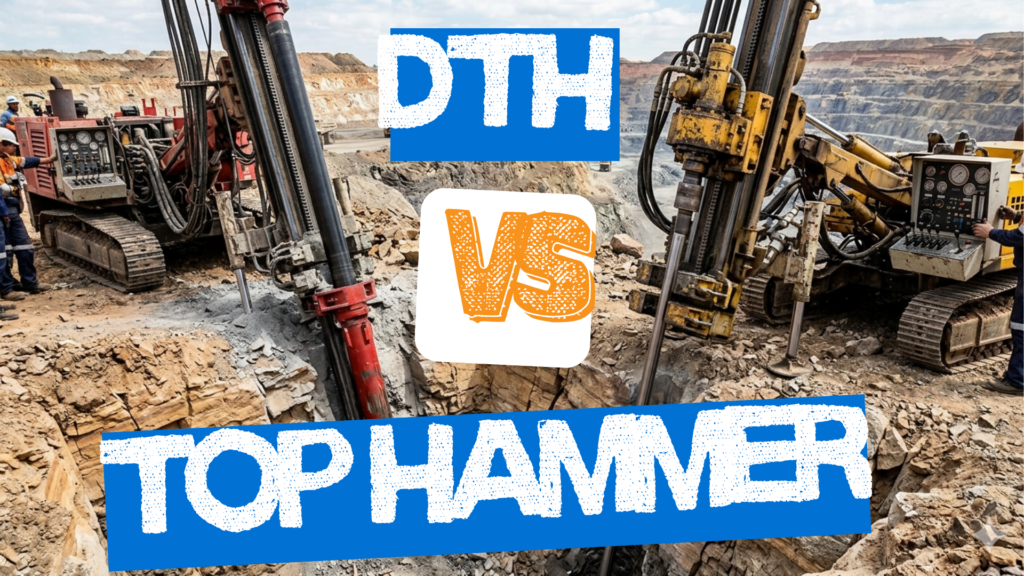
Analyzing Percussive Mechanics: The Core Choice
In rock drilling, selecting the right method isn’t a matter of brand loyalty or habit; it is a question of physics. When evaluating Down The Hole (DTH) versus Top Hammer drilling, the decision dictates the efficiency of your entire project, the wear rate of your tooling, and ultimately, your cost per foot.
While both systems are designed to crush rock through percussive force, they handle the mechanics of energy transfer in fundamentally different ways. Understanding the crossover point where one system outpaces the other is critical for optimizing performance in complex formations.
Top Hammer: Maximum Speed in Shallow Ground
The mechanics of a Top Hammer system are rooted in high frequency energy delivery. The drifter sits on the mast, generating percussive energy that travels down the drill string to the bit. Because the steel rod must transmit both the rotation and the impact waves, the physics of this system favor shorter hole depths.
In the right application, typically shallower profiles, smaller diameters, and non caving formations, Top Hammer drilling is exceptionally fast. The penetration rates are high because the piston strikes the steel at a very high frequency, shattering the rock rapidly before the energy has a chance to dissipate.
However, Top Hammer systems face a strict mechanical limitation when pushed past their intended depth. As the hole gets deeper and more drill steel is added, the impact wave has to travel through more joints. Every thread interface absorbs and dissipates a percentage of that energy. Eventually, you hit a point of diminishing returns where the energy hitting the bit is significantly lower than the energy generated at the drifter, leading to increased deviation and accelerated thread wear.
DTH: Consistent Energy at Depth
Down The Hole drilling solves the energy dissipation problem by moving the hammer to where the work is actually being done, right behind the bit. In a DTH setup, the drill string does not transmit the percussive blow; it simply provides rotation and feeds the high pressure air that drives the internal piston.
Because the hammer strikes the bit directly at the bottom of the hole, the energy transfer remains constant, regardless of depth. There is virtually no loss of impact energy through the drill string because the strike happens right at the rock face.
From an engineering perspective, this makes DTH the definitive choice for deeper holes, larger diameters, and hard, competent rock formations. Because the drill tubes are rigid and experience less axial shock than Top Hammer rods, hole straightness is significantly improved. The trade off is frequency: DTH hammers operate at a lower blow rate than a top hammer drifter, meaning in shallow, softer ground, they will generally be outpaced by a Top Hammer setup.
The Crossover Point: Advantages and Disadvantages
Choosing between the two methods requires a clinical look at your specific project parameters. It isn’t just about depth; it’s about geology and fleet management.
- Top Hammer Advantages: High penetration rates in shallow ground, faster setup times, and highly efficient in smaller hole diameters.
- Top Hammer Disadvantages: Rapid energy loss as depth increases, higher risk of hole deviation on longer runs, and accelerated tooling fatigue caused by reflected shock waves bouncing back up the string into the threads.
- DTH Advantages: Constant energy transfer independent of depth, exceptional hole straightness due to rigid guide tubes, and longer tooling life in deep, hard rock applications.
- DTH Disadvantages: Slower penetration speeds in shallow or soft formations compared to high frequency systems, and higher volume air compressor requirements to properly cycle the hammer at depth.
Conclusion
There is no universal winner between DTH and Top Hammer. True efficiency comes from matching the system to the geology and the specific profile of the project. A mass produced catalog will tell you what a tool can do, but a technical understanding of energy transfer tells you what it should do.
By analyzing the physics of the application rather than just the equipment specs, contractors can ensure they are deploying the right method for the right ground, minimizing wear, maximizing energy, and keeping the rig turning efficiently.