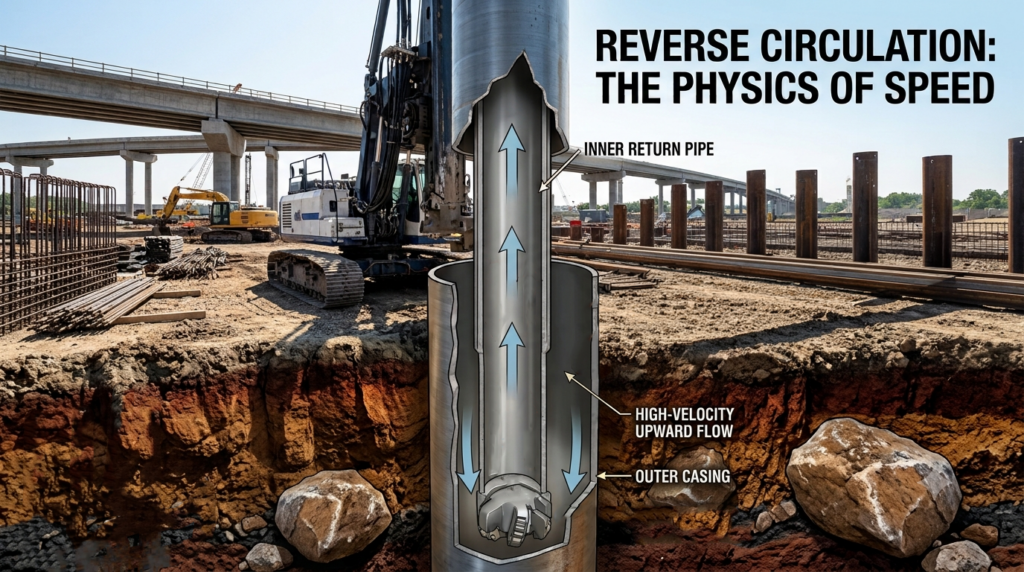
When contractors need to drill massive, deep holes into the earth for bridge foundations, skyscrapers, or industrial structures, they run into a major mechanical hurdle. With standard drilling, you pump water or drilling mud down the middle of the pipe to push rock chips back up to the surface through the empty space outside the pipe. But when a hole gets incredibly wide, that fluid slows down drastically as it enters the big space. The heavy rock chunks lose momentum, stall out, and fall right back to the bottom. To keep projects moving without destroying tooling, the industry flips the system upside down using a method called Reverse Circulation utilizing the air injection method. By changing how the air and fluid flow, this system makes heavy rock debris rush to the surface using a simple rule of physics.
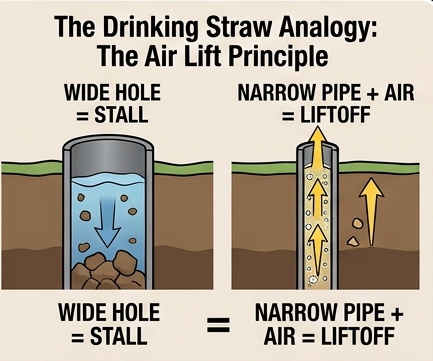
The Drinking Straw Analogy: The Air Lift Principle
To understand how this works, imagine trying to suck a heavy pebble up through a giant, wide straw. It is nearly impossible. But if you shrink the straw down and introduce bubbles into the liquid, everything changes. In a foundation Reverse Circulation setup, the big hole outside the drill pipe is kept completely full of heavy water. Inside that water sits a specialized, hollow drill pipe. Instead of pushing water down, the rig injects high pressure compressed air down into the pipe. This air travels down to the bottom of the hole and enters the inner return tube. As the air bubbles mix with the water inside the tube, it turns into a light, frothy foam. Because this bubbly mixture inside the pipe is much lighter than the heavy, solid water outside the pipe, nature wants to balance things out. The heavy water on the outside pushes down with immense pressure, forcing the light, bubbly water inside the pipe to rocket straight up to the surface like a shaken soda bottle.
High Speed Cleaning: Fluid Dynamics in Action
By forcing the water and rock debris to travel up the inside of the narrow pipe rather than up the wide, open hole, the system gains massive operational advantages. Because the inside of the drill pipe is a tight, confined space, the water moves incredibly fast. This high speed creates a powerful vacuum effect that carries large, heavy rock fragments cleanly out of the hole without needing high viscosity drilling muds.
Protecting the Hole: Safeguarding Borehole Walls
In standard drilling, rushing water can erode and scrape the dirt walls of the hole, causing cave ins. With Reverse Circulation, the water moves gently down the outside and rises violently only inside the steel pipe. Because the flushing current travels downward through the outer annular space at a low velocity and rises entirely inside the steel drill string, the fragile walls of the unlined borehole are completely protected from high pressure erosion. This significantly mitigates the risk of caving in unstable formations.
Job Site Setup: The Mechanical Assembly
Executing an air injection project requires a specific layout of heavy equipment working in tandem. First, a heavy steel casing is driven into the top section of the ground to keep the surface dirt from collapsing. A specialized drilling platform is then lowered directly onto that steel casing and locked tight with high powered hydraulic clamps to keep everything stable. A heavy duty cutting head, equipped with massive steel teeth or rollers designed to crush rock harder than concrete, is lowered to the bottom of the hole. Single hollow or multi wall drill rods are sequentially screwed together to form a highly rigid drill string. At the top of the rig, a specialized swivel routes the incoming air down into the pipe while directing the muddy, rocky slurry out through a heavy rubber hose. This allows the debris to be piped directly into containment tanks, cleaning systems, or disposal barges, keeping the job site spotless.
Maximizing Production: The Bottom Line
Air injection drilling succeeds because it stops trying to fight the physics of a giant hole. By trapping the return flow inside a narrow steel pipe and using air bubbles to lift the weight, it guarantees that rock debris is cleared away instantly. For large diameter deep foundations, this clever pressure balance is what keeps projects on schedule, protects the hole from collapsing, and ensures a clean, predictable job site from start to finish.