Beyond the Podium: Key Takeaways from ADSC Edmonton 2026

A different perspective of an industry function

Industry conferences are often viewed through the lens of networking, whether that means a quick handshake over coffee or a round on the golf course. While those personal connections are vital, the true, long-term return on investment from events like the ADSC Western Canadian Chapter Seminar & Golf Tournament lies in the open exchange of technical knowledge.

As Western Canada’s infrastructure demands grow and ground conditions become increasingly unpredictable, the deep foundation sector is facing a new set of baseline challenges. Tight urban footprints, strict environmental regulations around slurry and spoil management, and complex geology mean that relying on traditional drilling methods is no longer a guaranteed strategy. Overcoming these field realities requires a shift in how we approach job planning, moving away from reactive troubleshooting toward proactive, physics-based execution.

Following our time in Edmonton, one core message stood out: operational efficiency is not just about the sheer size or horsepower of the rig. It is driven by continuous technical education and a shared willingness across the industry to collaborate on complex mechanical problems.

Ground-Level Insights: Physics, Mechanics, and Field Reality

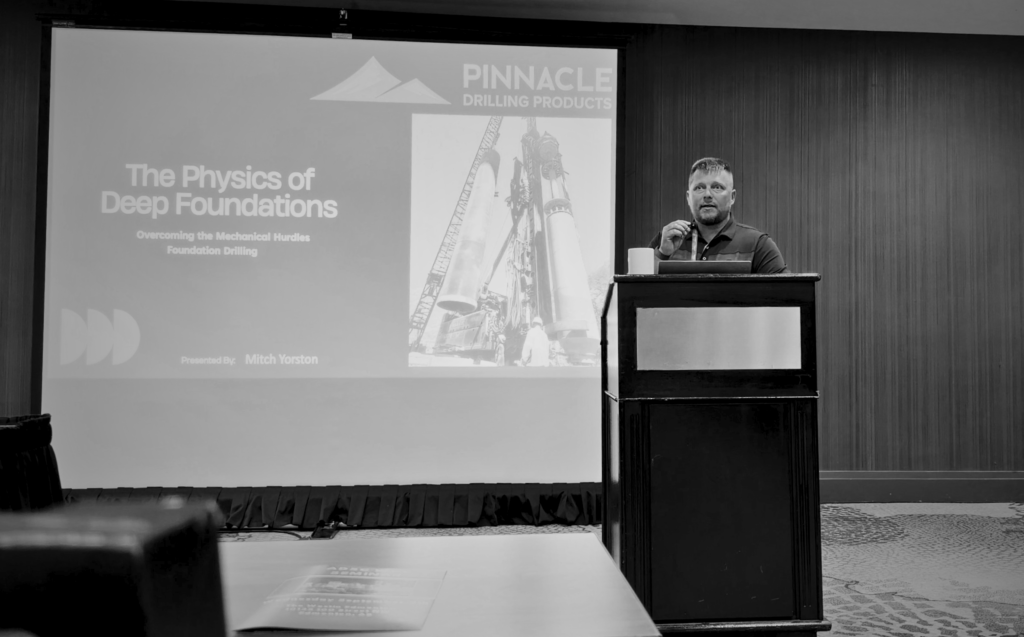
During the technical seminar, our guy Mitch Yorston (Outside Sales & Technical Lead) took the stage to address these exact themes in his presentation, “The Physics of Deep Foundations: Overcoming the Mechanical Hurdles of Foundation Drilling.”

Rather than walking the room through a conventional sales pitch, Mitch focused on the fundamental mechanics, fluid dynamics, and operational logic that dictate success in heavy drilling operations. Using Foundation Reverse Circulation (RC) Drilling as a central case study, he explored how air path mechanics, hole stability, and flushing velocity intersect when managing challenging formations.

The most encouraging part of the session, however, was not what was presented on the slides; it was the active dialogue that followed. The presentation sparked a series of collaborative breakout discussions among contractors, geotechnical engineers, and tooling specialists. The room dove into real-world field scenarios, touching on several key operational themes:

  • Navigating Difficult Formations: Openly comparing notes on hole stability challenges in cobble-heavy overburden, high groundwater inflows, and deep rock sockets where conventional drilling often stalls out.
  • Site Footprint and Environmental Handling: Discussing how closed-loop air dynamics and continuous chip removal can streamline spoil control on space-constrained urban job sites.
  • Fleet Adaptability: Exploring practical ways contractors can retrofit existing drill rigs or deploy modular hanging leads to adapt to RC capabilities without needing entirely new carrier units.

Seeing peers from competing firms and different disciplines come together to dissect these mechanical hurdles was a testament to the strength of Western Canada’s foundation community.

Continuous Learning Drives On-Site Success

Events like ADSC serve as a great reminder that equipment performance is ultimately capped by application knowledge. A piece of tooling is only as effective as the mechanical strategy behind it, and sharing field-tested insights elevates operational standards for the entire sector.

When contractors share what works, engineers gain better insight into constructability, suppliers refine their tooling designs, and the entire industry benefits from safer, more predictable project outcomes.

A big thank you to the ADSC Western Canadian Chapter team, the event organizers, the venue staff, and everyone who took the time to connect, ask sharp questions, and share their field perspectives with us in Edmonton. We look forward to continuing these conversations throughout the season.
The Physics of Deep Foundations: How Air Changes the Game in Big Hole Drilling

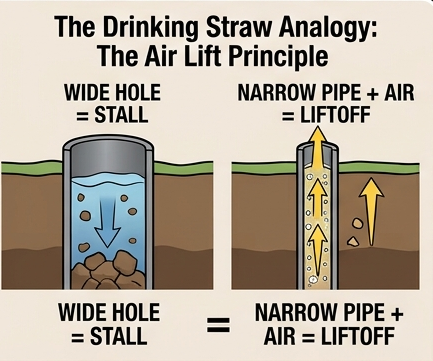
When contractors need to drill massive, deep holes into the earth for bridge foundations, skyscrapers, or industrial structures, they run into a major mechanical hurdle. With standard drilling, you pump water or drilling mud down the middle of the pipe to push rock chips back up to the surface through the empty space outside the pipe. But when a hole gets incredibly wide, that fluid slows down drastically as it enters the big space. The heavy rock chunks lose momentum, stall out, and fall right back to the bottom. To keep projects moving without destroying tooling, the industry flips the system upside down using a method called Reverse Circulation utilizing the air injection method. By changing how the air and fluid flow, this system makes heavy rock debris rush to the surface using a simple rule of physics.

The Drinking Straw Analogy: The Air Lift Principle

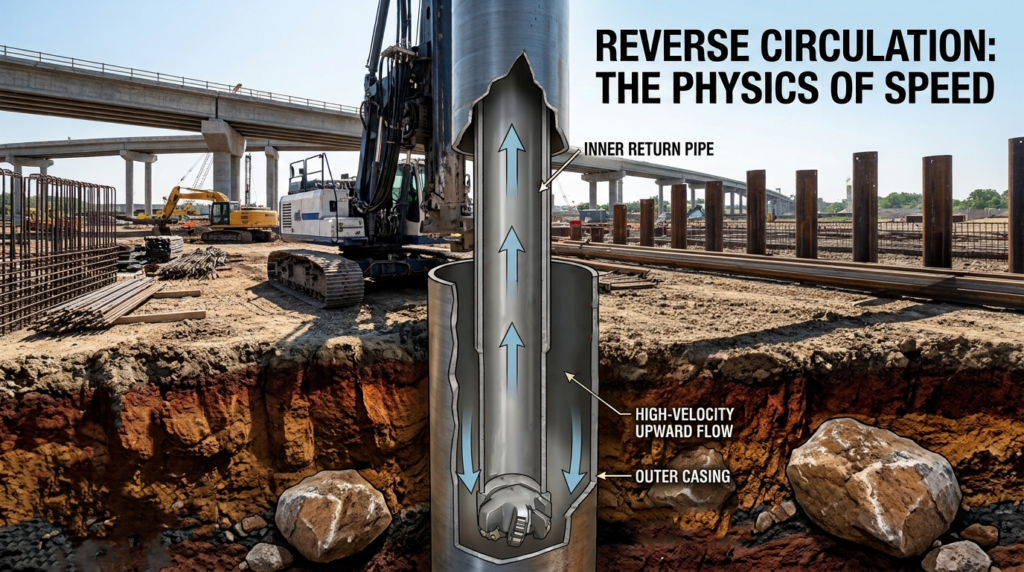
To understand how this works, imagine trying to suck a heavy pebble up through a giant, wide straw. It is nearly impossible. But if you shrink the straw down and introduce bubbles into the liquid, everything changes. In a foundation Reverse Circulation setup, the big hole outside the drill pipe is kept completely full of heavy water. Inside that water sits a specialized, hollow drill pipe. Instead of pushing water down, the rig injects high pressure compressed air down into the pipe. This air travels down to the bottom of the hole and enters the inner return tube. As the air bubbles mix with the water inside the tube, it turns into a light, frothy foam. Because this bubbly mixture inside the pipe is much lighter than the heavy, solid water outside the pipe, nature wants to balance things out. The heavy water on the outside pushes down with immense pressure, forcing the light, bubbly water inside the pipe to rocket straight up to the surface like a shaken soda bottle.

High Speed Cleaning: Fluid Dynamics in Action

By forcing the water and rock debris to travel up the inside of the narrow pipe rather than up the wide, open hole, the system gains massive operational advantages. Because the inside of the drill pipe is a tight, confined space, the water moves incredibly fast. This high speed creates a powerful vacuum effect that carries large, heavy rock fragments cleanly out of the hole without needing high viscosity drilling muds.

Protecting the Hole: Safeguarding Borehole Walls

In standard drilling, rushing water can erode and scrape the dirt walls of the hole, causing cave ins. With Reverse Circulation, the water moves gently down the outside and rises violently only inside the steel pipe. Because the flushing current travels downward through the outer annular space at a low velocity and rises entirely inside the steel drill string, the fragile walls of the unlined borehole are completely protected from high pressure erosion. This significantly mitigates the risk of caving in unstable formations.

Job Site Setup: The Mechanical Assembly

Executing an air injection project requires a specific layout of heavy equipment working in tandem. First, a heavy steel casing is driven into the top section of the ground to keep the surface dirt from collapsing. A specialized drilling platform is then lowered directly onto that steel casing and locked tight with high powered hydraulic clamps to keep everything stable. A heavy duty cutting head, equipped with massive steel teeth or rollers designed to crush rock harder than concrete, is lowered to the bottom of the hole. Single hollow or multi wall drill rods are sequentially screwed together to form a highly rigid drill string. At the top of the rig, a specialized swivel routes the incoming air down into the pipe while directing the muddy, rocky slurry out through a heavy rubber hose. This allows the debris to be piped directly into containment tanks, cleaning systems, or disposal barges, keeping the job site spotless.

Maximizing Production: The Bottom Line

Air injection drilling succeeds because it stops trying to fight the physics of a giant hole. By trapping the return flow inside a narrow steel pipe and using air bubbles to lift the weight, it guarantees that rock debris is cleared away instantly. For large diameter deep foundations, this clever pressure balance is what keeps projects on schedule, protects the hole from collapsing, and ensures a clean, predictable job site from start to finish.