A different perspective of an industry function
Industry conferences are often viewed through the lens of networking, whether that means a quick handshake over coffee or a round on the golf course. While those personal connections are vital, the true, long-term return on investment from events like the ADSC Western Canadian Chapter Seminar & Golf Tournament lies in the open exchange of technical knowledge.
As Western Canada’s infrastructure demands grow and ground conditions become increasingly unpredictable, the deep foundation sector is facing a new set of baseline challenges. Tight urban footprints, strict environmental regulations around slurry and spoil management, and complex geology mean that relying on traditional drilling methods is no longer a guaranteed strategy. Overcoming these field realities requires a shift in how we approach job planning, moving away from reactive troubleshooting toward proactive, physics-based execution.
Following our time in Edmonton, one core message stood out: operational efficiency is not just about the sheer size or horsepower of the rig. It is driven by continuous technical education and a shared willingness across the industry to collaborate on complex mechanical problems.
Ground-Level Insights: Physics, Mechanics, and Field Reality
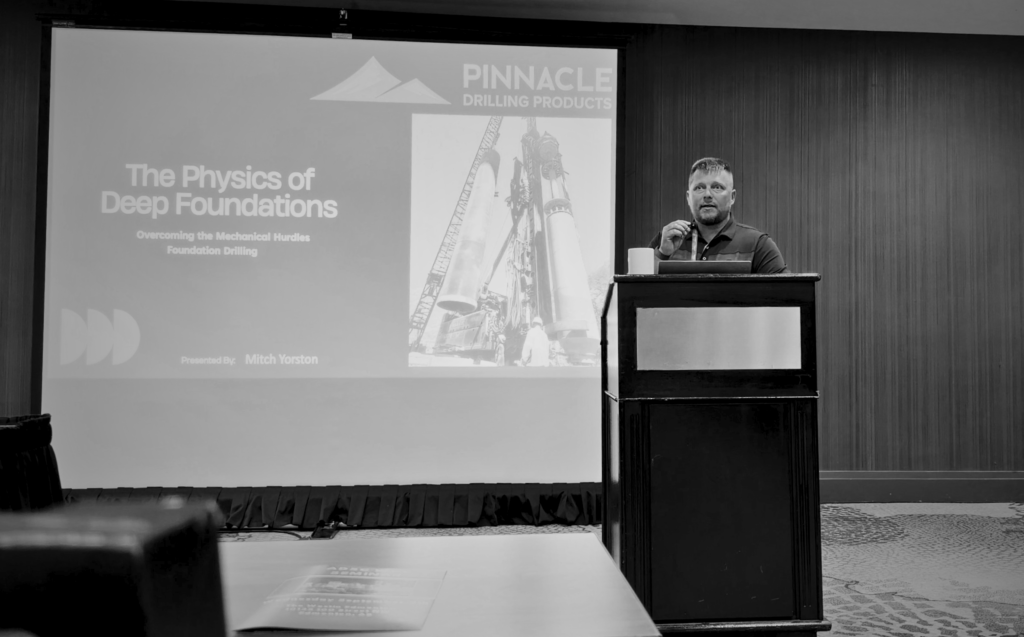
During the technical seminar, our guy Mitch Yorston (Outside Sales & Technical Lead) took the stage to address these exact themes in his presentation, “The Physics of Deep Foundations: Overcoming the Mechanical Hurdles of Foundation Drilling.”
Rather than walking the room through a conventional sales pitch, Mitch focused on the fundamental mechanics, fluid dynamics, and operational logic that dictate success in heavy drilling operations. Using Foundation Reverse Circulation (RC) Drilling as a central case study, he explored how air path mechanics, hole stability, and flushing velocity intersect when managing challenging formations.
The most encouraging part of the session, however, was not what was presented on the slides; it was the active dialogue that followed. The presentation sparked a series of collaborative breakout discussions among contractors, geotechnical engineers, and tooling specialists. The room dove into real-world field scenarios, touching on several key operational themes:
- Navigating Difficult Formations: Openly comparing notes on hole stability challenges in cobble-heavy overburden, high groundwater inflows, and deep rock sockets where conventional drilling often stalls out.
- Site Footprint and Environmental Handling: Discussing how closed-loop air dynamics and continuous chip removal can streamline spoil control on space-constrained urban job sites.
- Fleet Adaptability: Exploring practical ways contractors can retrofit existing drill rigs or deploy modular hanging leads to adapt to RC capabilities without needing entirely new carrier units.
Seeing peers from competing firms and different disciplines come together to dissect these mechanical hurdles was a testament to the strength of Western Canada’s foundation community.
Continuous Learning Drives On-Site Success
Events like ADSC serve as a great reminder that equipment performance is ultimately capped by application knowledge. A piece of tooling is only as effective as the mechanical strategy behind it, and sharing field-tested insights elevates operational standards for the entire sector.
When contractors share what works, engineers gain better insight into constructability, suppliers refine their tooling designs, and the entire industry benefits from safer, more predictable project outcomes.
A big thank you to the ADSC Western Canadian Chapter team, the event organizers, the venue staff, and everyone who took the time to connect, ask sharp questions, and share their field perspectives with us in Edmonton. We look forward to continuing these conversations throughout the season.